

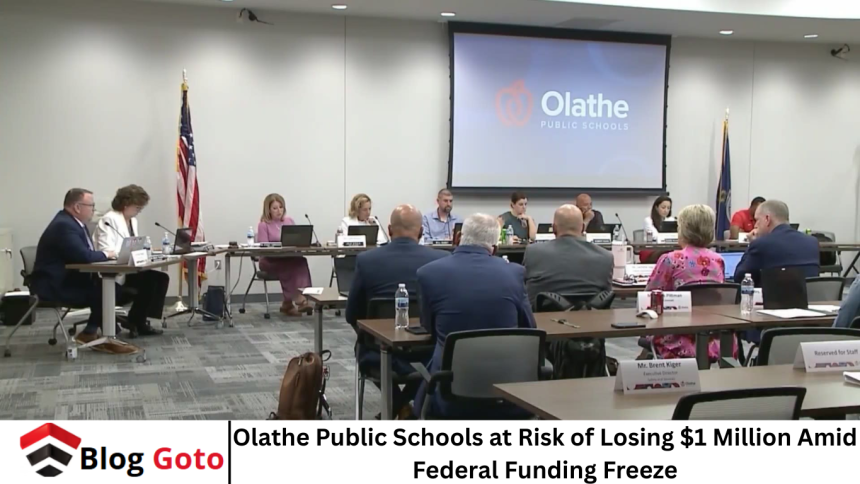
Olathe Public Schools, one of Kansas’s largest school districts, is facing a serious financial challenge: the potential loss of more than $1 million in federal funding. This setback stems from a sweeping freeze imposed by the U.S. Olathe Public Schools, a cornerstone of educational excellence in Kansas, is now at the heart of a growing national controversy over federal education funding.
Department of Education, which has temporarily halted the distribution of billions in grant money to school districts nationwide. The impact is particularly harsh for programs serving vulnerable student populations—those who rely on English language learning, migrant support, mental health resources, and teacher development.
As the 2025–2026 academic year approaches, Olathe educators, parents, and administrators are scrambling to adjust plans and reallocate budgets while urging federal officials to lift the freeze. This article explores the cause of the funding freeze, its effects on Olathe schools, broader regional implications, and what lies ahead for public education in Kansas.
More Read: Trump Admin Subpoenas Harvard, Threatens Accreditation
Context: The Federal Funding Freeze
What’s Happening
In early July 2025, the U.S. Department of Education announced a temporary freeze on nearly $6.8 billion in congressional grants for K–12 schooling. This includes funding for migrant education, teacher development, English fluency, academic enrichment, as well as after‑school and summer programs.
The freeze is part of a federal “programmatic review” and was justified by concerns that some grants might have been used to support a “radical leftwing agenda,” including immigrant scholarships and LGBTQ-themed curriculum
Reuters.
The Regional Impact
As a result, Kansas and Missouri school systems are collectively experiencing a shortfall of approximately $129 million, with $50 million specifically delayed from Kansas districts.
Kansas City Public Schools alone faces a $4.1 million deficit; Shawnee Mission is down nearly $1 million; Lee’s Summit about $1.3 million.
Broader Regional Ramifications
Neighboring districts are also under strain:
- Kansas City Public Schools: Frozen funds exceeding $4.1 million.
- Shawnee Mission School District: Nearly $1 million withheld.
- Lee’s Summit: Around $1.3 million impacted.
- Blue Valley Schools: Facing delays of approximately $342,000.
These freezes threaten after‑school and summer learning programs just as the academic year approaches.
Why These Grants Matter
- Teacher Support & Quality – Title II funds cover training, recruitment, and retention of high-quality educators. With teacher shortages ongoing, this support is crucial.
- Equity & Inclusion Programs – Title III and ESEA funds support English language learners, immigrant, and migrant students, fostering educational inclusion.
- Mental Health & Trauma Support – In a post-pandemic landscape, grants help address rising student mental health needs.
- Student Enrichment – Title IV supports academic enrichment and after-school programs vital for broadening learning opportunities.
Many OPS-backed contracts and salaries are tied directly to these federal dollars—meaning sudden withdrawal of funds forces immediate budget adjustments.
OPS’s Response & Strategy
According to official communications from July 8, 2025:
OPS states it will reallocate district funds to fill in gaps—but doing so risks straining other programs.
- The district is actively advocating for prompt federal action to release the funds.
- OPS is keeping families and staff informed through ongoing communications.
- At a July 12 Board meeting, finance officials also noted uncertainty over future federal voucher programs but reaffirmed plans to monitor developments closely.
The Bigger Picture & National Context
- The funding freeze stems from nationwide measures under the Trump administration, affecting programs totaling nearly $7 billion.
- A lawsuit by 24 Democratic-led states and D.C. accuses the executive branch of violating constitutional and administrative rules by halting funding without Congressional or formal procedure.
- Nationally, school districts are scrambling to manage canceled summer programs and after-school initiatives due to funding uncertainty.
What’s at Stake?
- Short-Term: Students may lose access to essential mental health support, language instruction, and enrichment.
- Operational Strains: Schools may defer hiring, reduce staff hours, or cut programs mid-stream—messing with budgets and commitments.
- Long-Term Equity Effects: Lower-performing or under-resourced student groups (e.g., English learners, migrants, low-income) are disproportionately affected.
- Legal/Procedural Questions: The executive branch’s action has prompted scrutiny and legal challenges highlighting concerns over executive authority versus Congressional oversight.
Outlook & Anticipated Developments
- Legal Backdrop: Pending lawsuits could compel the Education Department to resume funding if courts find the freeze unlawful.
- Political & Legislative Pressure: State governments, school boards, and parent groups may urge federal officials to resume disbursements.
- District Adaptation: OPS and other districts will likely utilize fund reserves temporarily—though reserves are limited.
- Future Budget Risks: Continued freezes or policy shifts could affect next year’s budget planning and stability.
Next Steps for Stakeholders
- Parents & Teachers: Stay alert to updates from OPS, attend board meetings, and voice concerns directly to state/federal lawmakers.
- Educators & Staff: Prepare for potential shifts in program delivery, be flexible in reallocating duties, and optimize local partnerships.
- Community & Advocacy Groups: Support school districts through public forums, legal advocacy, and fundraising.
- Policymakers: Evaluate legal standing of the freeze and consider reinforcing budget commitments through state-level action.
✅ Frequently Asked Question
How much exactly is Olathe losing?
A: Olathe Public Schools is facing a shortfall of approximately $1,031,726—including already allocated funds for staff salaries (~$570K) and critical student and teacher support services.
What programs are most affected?
A: The most affected areas are teacher training/recruitment ($452K), ELL/immigrant services ($369K), mental health supports ($131K), and migrant education ($80K).
Is the freeze permanent?
A: Not necessarily. It’s categorized as a “freeze” pending review—not a permanent cancellation. Lawsuits and administrative actions may force a release of funds.
What can the district do now?
A: OPS plans to reallocate internal funds temporarily and is lobbying for the release of federal funds. However, reallocating affects other programs and is far from ideal.
Will local taxes increase?
A: Possibly. If enough federal support fails to materialize, OPS may need to shift burden onto local taxpayers to sustain programs.
How does this compare to other districts?
A: Olathe isn’t alone—KCPS lost over $4.1M, Shawnee Mission nearly $1M, Lee’s Summit $1.3M, Blue Valley $342K, and Kansas City, KS, $4.9M.
How can parents help?
A: Engage with school board communications, write to federal/state reps, attend school or community meetings, and consider grassroots support or donations to critical programs.
Conclusion
Olathe Public Schools is at serious risk of losing over $1 million in federal funds—coupling with pressing needs in teacher training, immigrant student support, and mental health services. The district is scrambling to bridge the gap with internal resources while advocating for policy reversal. This isn’t just a local setback—it reflects a broader nationwide tension over federal funding priorities and executive authority. For OPS families, educators, and Kansas taxpayers, the implications are immediate and far-reaching.