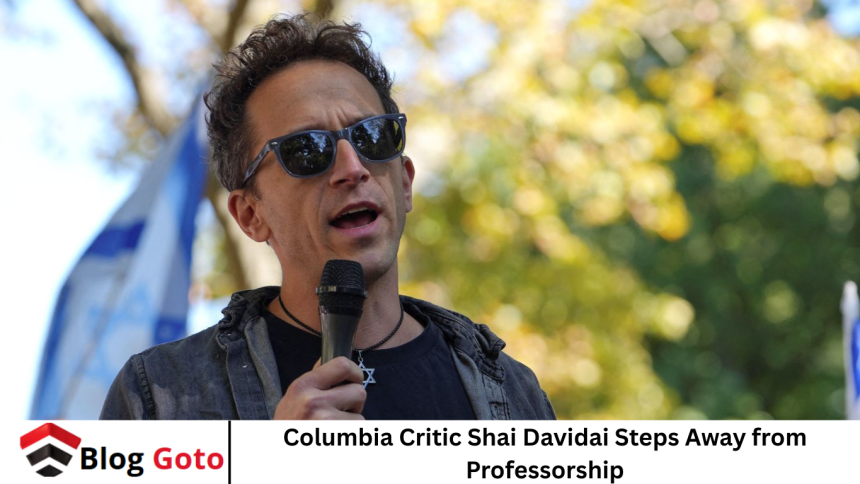
In a move that has sparked national discussion, Columbia University professor Shai Davidai—known for his outspoken criticism of the university’s handling of antisemitism and free speech issues—has officially stepped away from his teaching responsibilities.
The announcement follows months of heated campus protests, media appearances, and social media statements in which Davidai positioned himself as a leading voice against what he described as institutional silence and complicity in antisemitism at the Ivy League institution.
His departure, described as a “leave of absence,” comes at a time when elite American universities are grappling with intense scrutiny over their responses to hate speech, student activism, and political polarization, particularly in light of ongoing tensions in the Middle East.
More Read: Olathe Public Schools at Risk of Losing $1 Million Amid Federal Funding Freeze
Who Is Shai Davidai?
Shai Davidai is an assistant professor at Columbia Business School, where he taught behavioral science and decision-making. With a Ph.D. in psychology from Cornell University, Davidai earned recognition for his research on inequality, fairness, and moral psychology.
However, he became a household name not for academic publications but for his vocal criticism of Columbia University’s alleged mishandling of antisemitism and campus unrest. Davidai rose to national prominence in late 2023 and early 2024 when he began speaking out publicly about what he perceived as antisemitic sentiment on Columbia’s campus.
His statements resonated with some Jewish students and alumni, while drawing backlash from progressive student groups and faculty who saw his criticisms as inflammatory or politically motivated.
The Rise of a Campus Critic
He frequently criticized the university’s leadership, including President Minouche Shafik, claiming they had failed to ensure campus safety for all students, regardless of ethnicity or religion. In one widely circulated video, Davidai stood on the Columbia campus and declared, “This is not a place of free inquiry anymore. This is a place where hatred is tolerated—and selectively so.”
Davidai’s emergence as a campus critic began shortly after the outbreak of the Israel-Hamas war in October 2023. As universities across the United States became hotbeds for protests and political expression, Columbia found itself at the center of controversy.
Students organized rallies, sit-ins, and open letters—some in support of Palestinians, others expressing solidarity with Israel or decrying antisemitism on campus. Amid this climate, Davidai made public appearances and published op-eds in which he accused Columbia administrators of turning a blind eye to the intimidation of Jewish students.
Events Leading to the Leave of Absence
While Columbia never issued a formal reprimand against Davidai, tensions were mounting within academic and administrative circles. Some faculty expressed discomfort with Davidai’s tactics, accusing him of contributing to a hostile campus environment.
In May 2025, after a particularly tense semester marked by protests, arrests, and national attention on antisemitism in higher education, Davidai announced that he would be taking a leave of absence from his professorial duties. His departure was described as temporary, though neither Columbia nor Davidai have confirmed a return date.
Observers are split on whether the leave was voluntary or the result of pressure behind closed doors.
Campus Reaction
The reaction to Davidai’s leave has been deeply polarized, mirroring the broader national debate over free speech, academic freedom, and campus activism. The Columbia Student Union released a statement calling for a more inclusive dialogue and accusing Davidai of “weaponizing identity politics for personal and political gain.”
Supporters praised his courage and criticized the university for not standing up to what they called “mob rule.” Many Jewish students and advocacy groups, including some outside of Columbia, rallied in support of Davidai, viewing him as a rare voice defending Jewish identity in elite academic spaces.
Critics, on the other hand, accused Davidai of fanning the flames of division and using his platform to promote a one-sided political narrative. Some students claimed his rhetoric made the campus less safe for Palestinian and Arab students, who they say were already feeling marginalized.
Columbia’s Response
Columbia University has remained mostly silent on the specifics of Davidai’s departure, stating only that it supports the academic freedom of all its faculty while working to ensure a safe environment for all students. President Shafik has faced calls from both sides—some demanding stronger action against antisemitism, others urging protection for pro-Palestinian voices.
In April 2025, Shafik testified before Congress alongside other university leaders in a high-profile hearing on antisemitism in higher education. During the hearing, Davidai’s name was repeatedly brought up as a symbol of faculty discontent with university inaction.
Despite repeated inquiries from journalists, Columbia has declined to say whether Davidai’s leave is connected to internal disciplinary processes or concerns about campus climate.
The National Spotlight
Davidai’s case is not isolated. Across the U.S., multiple professors have found themselves at the center of cultural and political clashes on campus. The broader conversation includes issues such as:
- How universities define hate speech
- Whether certain ideologies are protected more than others
- The balance between academic freedom and institutional responsibility
Conservative media outlets, including Fox News, The Wall Street Journal, and The New York Post, have featured Davidai prominently. Simultaneously, progressive scholars and journalists have critiqued the media frenzy as ignoring nuance and reducing complex campus dynamics to simplistic binaries.
The Future of Academic Dissent
Davidai’s leave raises pressing questions about the future of dissent in academia. While universities pride themselves on being places of open inquiry, the reality is that professors, like students, are not immune to political and institutional pressures.
Whether Davidai returns to Columbia or not, his actions have forced a public reckoning on questions such as:
- Can a professor criticize their university without retaliation?
- What are the boundaries of acceptable activism for faculty?
- How should institutions respond to polarizing figures in their ranks?
His case could set a precedent for how universities handle vocal internal critics going forward.
Frequently Asked Question
Who is Shai Davidai?
Shai Davidai is an assistant professor at Columbia Business School, specializing in behavioral science and decision-making. He became widely known for publicly criticizing Columbia University’s handling of antisemitism and free speech issues.
Why did Shai Davidai take a leave from Columbia?
Davidai announced a leave of absence in May 2025 amid rising tensions on campus regarding antisemitism, protests, and his vocal criticism of the university. The exact reasons behind the leave—whether voluntary or pressured—have not been officially disclosed.
What has Davidai said about Columbia University?
Davidai has accused Columbia of allowing antisemitic sentiment to flourish and failing to protect Jewish students. He has also criticized the administration for selectively applying free speech protections.
How have students reacted to Davidai’s stance?
Student reactions are split. Some Jewish and pro-Israel students view him as a brave advocate. Others, particularly pro-Palestinian groups, say his rhetoric contributes to division and creates a hostile campus climate.
Has Columbia commented on Davidai’s leave?
Columbia has not provided detailed comments on Davidai’s leave. The university maintains that it supports academic freedom while ensuring a safe learning environment for all students.
Is this part of a broader trend in academia?
Yes. Davidai’s case is part of a growing number of high-profile incidents where professors face backlash—both supportive and critical—for speaking out on controversial social and political issues.
Will Shai Davidai return to Columbia?
It is currently unclear whether Davidai will return to teaching at Columbia. Neither he nor the university has confirmed any plans for his reinstatement or long-term future with the institution.
Conclusion
Shai Davidai’s decision to take leave from his professorship at Columbia University marks a significant moment in the ongoing struggle between free expression, academic responsibility, and campus activism. Whether seen as a hero, a provocateur, or something in between, Davidai has sparked necessary debates in an increasingly polarized academic landscape. As Columbia University—and higher education more broadly—wrestles with its identity and role in a divided society, the impact of Davidai’s leave will continue to resonate.