
Imagine a vaccine that is not taken off a shelf, but built for one person, using the genetic fingerprints of that person’s own cancer. That is the idea behind NeoVax, a personalised neoantigen vaccine tested in a small phase 1 study in women with platinum-sensitive recurrent ovarian cancer. The results, published in Nature Medicine, were combined with nivolumab, a PD-1 immune checkpoint inhibitor. It is important to be clear from the start about what this study was: an early feasibility and safety trial, not proof that the treatment works against cancer. Larger studies would be needed before anyone could claim that.
Ovarian cancer that returns after platinum-based chemotherapy is difficult to treat, and new approaches are badly needed. Neoantigens are attractive targets because they arise from mutations found in tumour cells but not in healthy tissue. In theory, teaching the immune system to recognise those abnormal markers could help it spot cancer cells it had previously overlooked. Our coverage of how wearable technology is changing diabetes care in trials showed a similar pattern in another field: careful early studies first establish whether a promising idea can actually be delivered to patients in real clinical conditions.
How a personalised vaccine is put together
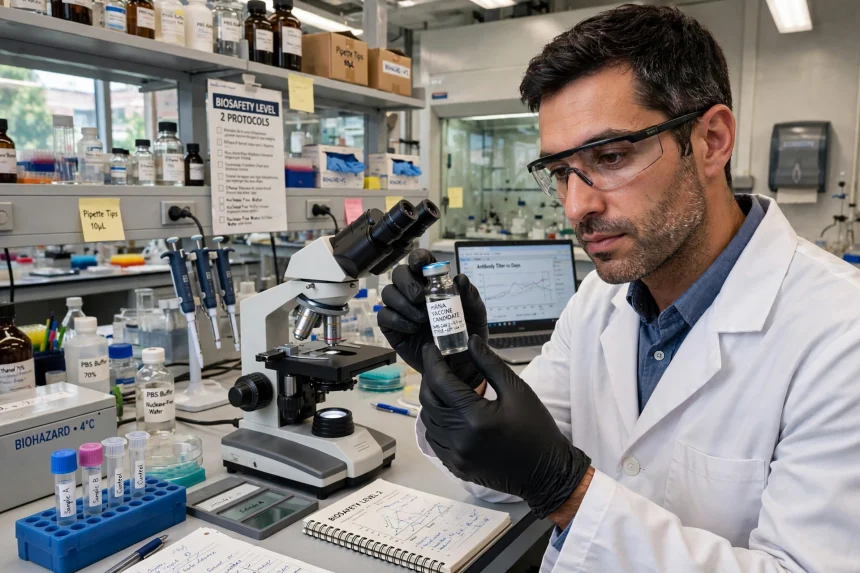
The process begins with sequencing a patient’s tumour to find its mutations. Scientists then predict which mutated fragments are most likely to be displayed on the surface of cancer cells and recognised by the immune system. Those selected neoantigens are manufactured into a vaccine tailored to that individual. It is a demanding pipeline involving laboratories, prediction software and quality checks, and one of the central questions of the trial was simply whether it could be done reliably and in time for patients with recurrent disease. According to the published report in Nature Medicine, the vaccines could indeed be manufactured and administered to the patients enrolled, which is a meaningful practical step even before any question of benefit is considered.
Why nivolumab was added to the mix
A vaccine can train immune cells, but tumours often survive by applying brakes to the immune response. Nivolumab blocks PD-1, one of those braking signals, and is already used in several cancers. Pairing the two is a logical combination: the vaccine aims to create T cells that recognise the tumour’s neoantigens, while the checkpoint inhibitor aims to keep those cells active rather than switched off. The trial therefore tested the combination as a package, which also means its results cannot separate what each part contributed. That is normal for an early study, but it is another reason to read the findings carefully and modestly.
What the trial actually found
Three findings stand out, and all three are deliberately modest. First, the personalised vaccines could be made and given, showing the approach is feasible outside a laboratory concept. Second, safety was acceptable in this small group, with the combination tolerated well enough to justify further study. Third, researchers saw immune responses, including T-cell activity directed at vaccine targets, suggesting the biological idea behaved as hoped. What the study did not show is equally important: it was not designed to prove that patients lived longer or that tumours shrank because of the vaccine. The National Cancer Institute consistently advises that early-phase results like these are a basis for further trials, not a reason to change treatment today.
What patients should take from the news
If you or a family member is facing recurrent ovarian cancer, this research is best read as a signpost rather than a destination. Personalised vaccines are moving from theory into real clinics, manufacturing is becoming practical, and the immune signals researchers want to see are appearing. The next steps are larger, controlled trials that can test whether those signals translate into genuine clinical benefit, and for which patients. Anyone considering an experimental approach should discuss clinical trial options with their oncology team, who can judge eligibility and timing. Hope is justified here, but so is patience: this is the first chapter of a long evaluation, written carefully in a respected journal, and its authors designed it that way.