

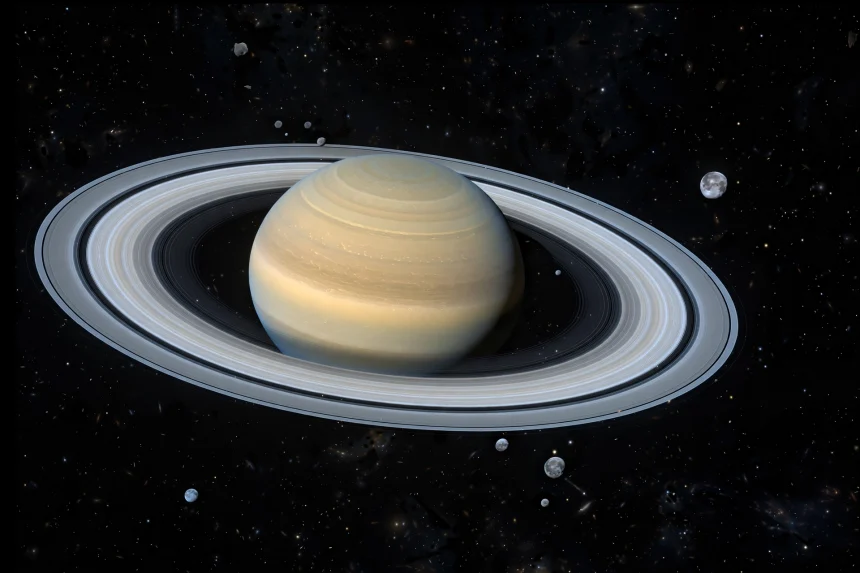
Saturn has never been a lonely planet, but its neighbourhood turns out to be far busier than anyone realised. Astronomers have confirmed 128 new moons orbiting the ringed giant, lifting its official total to 274. That is more moons than every other planet in the solar system combined, and it comfortably beats Saturn’s own previous tally of 146. For readers who enjoy a good record being broken, this is a big one: a single survey has nearly doubled the number of known worlds, however small, circling one planet.
The confirmation came after years of patient observing rather than a single dramatic night. The team worked with the Canada-France-Hawaii Telescope on Mauna Kea, gathering deep images over several observing seasons and then comparing them carefully. Researchers linked to the University of British Columbia, including Dr Edward Ashton, played a central role in tracking the faint objects and calculating their orbits. Once the orbits were secure, the new moons were formally recognised by the International Astronomical Union, the body that keeps astronomy’s official lists.
Why these moons stayed hidden for so long
The simplest answer is size. Most of the newcomers are tiny, only a few kilometres across, which makes them incredibly faint against the glare of Saturn and the blackness around it. They also travel on distant, tilted orbits, and many move in the opposite direction to Saturn’s rotation, a pattern astronomers call retrograde. A small rock, far from its planet, moving the wrong way and reflecting very little sunlight is about as hard to spot as anything in the sky. It is less that telescopes suddenly improved overnight and more that observers finally combined enough deep images, taken over a long enough period, to reveal motion that a single snapshot could never show.
The shift and stack trick behind the find
The method has an unglamorous name and a clever logic. Called shift and stack, it involves taking many long-exposure images, shifting each one to follow the expected movement of a moon, and then stacking them together. Random stars and background noise blur or cancel out, while a real moving object lines up in frame after frame and grows brighter in the combined picture. Our recent explainer on how hidden structures in DNA are reshaping biology made a similar point in a different field: sometimes the discovery is not a new instrument, but a smarter way of reading data that was almost within reach. Patient analysis, repeated over years, is what turned faint smudges into 128 confirmed moons.
Broken pieces of much larger worlds
These irregular moons are probably not original building blocks that formed neatly beside Saturn. Astronomers believe many are fragments of larger moons that were captured by Saturn’s gravity long ago and later shattered in collisions. The evidence sits in their orbits: groups of the small moons share similar tilts and paths, like debris spreading slowly from a common break-up. Each cluster is, in effect, a family portrait of a collision that may have happened millions of years ago. Studying how the families are arranged helps researchers reconstruct when the impacts occurred and how violent Saturn’s outer system has been over its history.
What a bigger moon count actually changes
Nobody will need a bigger wall chart just yet, but the science matters. A complete census of small moons tells astronomers how material moved around the young solar system, how often passing objects were captured, and how collisions ground larger bodies into swarms of fragments. It also sharpens comparisons with Jupiter, whose own moon total now looks modest beside Saturn’s 274. The International Astronomical Union recognition matters too, because it turns candidate detections into a shared, checked record that other teams can build on. Expect follow-up observations to refine the orbits further, and do not be surprised if the count creeps up again. Saturn, it seems, has been collecting companions for billions of years, and we are only now learning how to count them properly.