

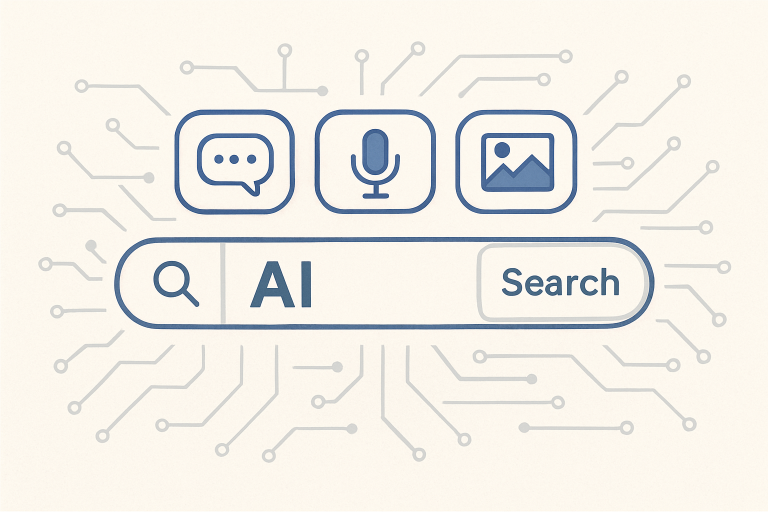
Artificial Intelligence (AI) is revolutionizing the way we search for information online. No longer confined to a list of static search results, modern search engines are transforming into intelligent platforms that recognize nuanced user needs and deliver relevant answers almost instantly. As technology advances, leveraging an SEO company to help your business grow becomes crucial to navigating this evolving digital landscape.
The integration of AI in search engines enhances the ability to handle complex queries that incorporate text, images, and voice, thereby creating a more personalized experience. This evolution is crucial for businesses and content creators to remain competitive. AI-driven search is becoming increasingly conversational, focusing on context and providing direct answers, which in turn elevates user expectations. As AI plays a significant role in digital experiences, marketers and content creators must stay current on AI trends and adjust their strategies to succeed in the evolving landscape of digital engagement.
AI Integration in Search Engines
Top search engines are embedding advanced AI to redefine the user experience. Google’s “AI Mode” leverages its powerful Gemini 2.0 model, designed to process multifaceted queries and return direct, comprehensive answers. By blending text, images, and voice, modern search is becoming much more interactive. Microsoft’s Bing and other search leaders are also rolling out their own large language models, marking an industry-wide shift toward richer, AI-infused platforms.
This rapid development is changing the underlying logic of search. Instead of matching keywords, AI models can process natural language, understand context, and make connections across data points—offering responses that more closely resemble human conversation. According to a recent Reuters analysis, such advancements are fundamentally altering user behavior and expectations from search technology.
Enhanced User Experience
AI-powered search engines are built to understand intent, not just keywords. The result is a system that delivers concise, context-aware answers—often drawing from a variety of sources in real-time. Features like Google’s featured snippets and Bing’s AI summaries demonstrate how search has evolved to provide users with the information they need without requiring endless scrolling.
Voice search is also on the rise, thanks to natural language processing. Users can ask complex questions conversationally and receive exact, streamlined answers through their devices. The continual enhancement of contextual understanding means users spend less time searching and more time engaged with the information they seek, as highlighted by recent coverage in Business Standard.
Rise of AI-Powered Search Tools
The popularity of AI conversational tools, such as ChatGPT and Microsoft Copilot, is skyrocketing. By mid-2025, ChatGPT alone was fielding billions of prompts daily—a trend that signals a significant shift from traditional, link-based search to interactive, answer-based information retrieval. Users appreciate the ability to interact with AI to clarify, expand, or refine their queries in real time.
This shift is not limited to consumers. Educators, researchers, and professionals are utilizing AI-driven search assistants to streamline their workflows, validate sources, and access deeper, cross-disciplinary knowledge. The result is a digital transformation that impacts every facet of online discovery, collaboration, and productivity.
Impact on Digital Marketing Strategies
The evolution of search is driving a significant shakeup in digital marketing. Traditional Search Engine Optimization (SEO) is expanding to include Answer Engine Optimization (AEO), which focuses on structuring content for AI-generated answers and natural conversation. Marketers must pivot towards more interactive and context-driven content, anticipating the types of queries users will present to AI search assistants.
Additionally, featured snippets, AI summaries, and direct responses mean visibility often comes down to providing concise, well-organized, and trustworthy information. Brands that invest in schema markup, Q&A sections, and conversational tone are better positioned to surface in AI-driven results—making ongoing strategic updates vital to maintain digital relevance.
Challenges and Considerations
While AI enhances the user experience and search efficiency, it also introduces new risks. The accuracy of AI-generated answers heavily depends on the quality and diversity of training data, meaning misinformation or bias can inadvertently be amplified. Another concern is the potential reduction in website traffic, as users may receive complete answers directly from the search engine instead of clicking through to the sources.
Companies must vigilantly monitor and update their content to ensure their information is accurately reflected in AI search results. Additionally, ethical considerations around transparency, user privacy, and the impact of content monopolization by large platforms must be taken into account as AI’s role in search continues to expand.
Future Trends in AI Search
The future of AI-driven search points to even deeper personalization. Anticipate ongoing growth in voice and visual search capabilities, and the emergence of AI-powered digital agents that perform sophisticated research tasks on behalf of users. Real-time adaptability and contextual understanding will become the expected standard, making it more critical than ever for brands to stay ahead of these changes.
As technology evolves, businesses must remain agile and proactive in adopting the best practices for AI search visibility. This may include investing in AI tools, training teams in AEO strategies, and continuing to create high-quality, user-centered content.
Conclusion
Artificial Intelligence is rapidly transforming the way we search, interact, and make decisions online. Its ability to offer faster, increasingly personalized, and context-aware answers is setting a new standard for digital experiences. For businesses, individuals, and organizations, adapting to these changes is no longer optional—it’s an imperative for maintaining visibility and growth in a dynamic, AI-powered world.