
The CFA charter has been around since 1963, and finance hiring panels across markets like the US, UK, Singapore, and India still treat it as one of the strongest qualifications you can hold. Portfolio managers, equity analysts, and risk professionals regularly pursue it to move into more demanding roles.
But before anything else, most people want to know three things: Can I even apply for CFA? How much will this cost me? And how long will this actually take?
This article answers all three, with 2026-specific numbers and timelines.
CFA Eligibility: What the CFA Institute Actually Requires
The requirements are straightforward for the CFA exam, but a few details trip people up.
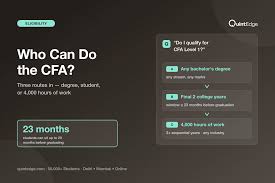
You need either a bachelor’s degree from an accredited university or 4,000 hours of relevant work experience in investment decision-making. Both pathways are valid. Final year undergraduate students can also register for Level 1 before graduation, which many people do not know.
Beyond the academic or work experience requirement, every candidate needs:
- A valid international travel passport
- Working proficiency in English, since all exams are conducted in English only
- Agreement to follow the CFA Institute Code of Ethics and Professional Conduct
One thing worth knowing: the 4,000 hour work experience requirement does not have to be completed before you attempt Level 1. You only need to submit verified experience when you apply for the actual charter after clearing Level 3. So students who register early are not at a disadvantage on that front.
CFA Exam Fees in 2026
Starting from February 2026, the CFA Institute removed the one-time $350 enrollment fee entirely. New candidates no longer pay that upfront cost. However, registration fees per level went up compared to 2025.
Fees also differ by level in 2026, which was not the case before. Level 3 costs more than Level 1 and Level 2.
| Fee Type | Level 1 and Level 2 (USD) | Level 3 (USD) |
| Early Registration | $1,140 | $1,240 |
| Standard Registration | $1,490 | $1,590 |
If you register early for all three levels, the total exam cost comes to $3,520. At standard registration rates, that number goes up to around $4,570. Neither figure accounts for study materials, prep programs, or practice tools.
Early registration windows open roughly four to five months before each exam date. Booking during that window saves $350 per level compared to the standard deadline. Across three levels, that adds up to $1,050 in savings.
The rescheduling fee remains at $250 if you need to change your exam appointment within the same window.
The Three CFA Exam Levels
The CFA certification course runs across three levels. Each one gets harder and shifts focus from knowledge recall toward application and judgment.
Level 1
This is where you build your base. Ten subject areas are tested: ethics, quantitative methods, economics, financial statement analysis, corporate issuers, equity investments, fixed income, derivatives, alternative investments, and portfolio management. The exam format is multiple choice. In 2026, Level 1 runs in February, May, August, and November.
Level 2
The questions here are longer and scenario based. You are given case vignettes and asked to apply your knowledge across the same subject areas, but at a much deeper level. Asset valuation gets heavier at this stage. Level 2 is offered in May, August, and November 2026.
Level 3
Level 3 moves into portfolio construction and wealth planning. The exam format changes here too. You get a mix of constructed response questions and item sets, where the answers are not just about picking the right option but writing out your reasoning.
The questions are built around real client scenarios. You are asked to make portfolio decisions for individual investors, institutions and different risk profiles. In 2026, there will be two windows for Level 3, which are February and August.
In recent years, pass rates have been in the 40-50 percent range for all three levels, with most candidates traditionally slowing down at Level 2.
How Long Does the CFA Certification Course Take?
The CFA Institute recommends a minimum of 300 study hours per level. In practice, many candidates log closer to 350 to 400 hours, especially for Level 2.
| Level | Suggested Study Hours | 2026 Exam Windows |
| Level 1 | 300 plus | Feb, May, Aug, Nov |
| Level 2 | 300 plus | May, Aug, Nov |
| Level 3 | 300 plus | Feb, Aug |
Most candidates take between two and five years to clear all three levels. Passing each on the first attempt is possible, but a large share of candidates retake at least one level before moving forward.
After clearing Level 3, there is still one step remaining. You need to submit 4,000 hours of verified work experience in investment-related roles, along with two to three professional references. The CFA Institute reviews and approves the submission before the charter is awarded.
What the CFA Curriculum Covers
All ten subject areas run through every level, though the topic weightage shifts as you progress. Ethics appears at all three levels and holds real marks in the final score. Many candidates underestimate it and lose points in a section that rewards consistent reading and application throughout the prep period.
- Ethical and Professional Standards
- Quantitative Methods
- Economics
- Financial Statement Analysis
- Corporate Issuers
- Equity Investments
- Fixed Income
- Derivatives
- Alternative Investments
- Portfolio Management and Wealth Planning
Final Word
Clearing the CFA certification course takes years, not months. The registration fees are not small, pass rates are unforgiving, and the study hours are non-negotiable. But for anyone targeting roles in investment research, asset management, or financial analysis, the CFA charter opens doors globally that most other finance qualifications do not.
If you want structured, mentor-supported preparation for the CFA, Zell Education offers programs built specifically around the demands of this course and the way finance professionals actually study.