

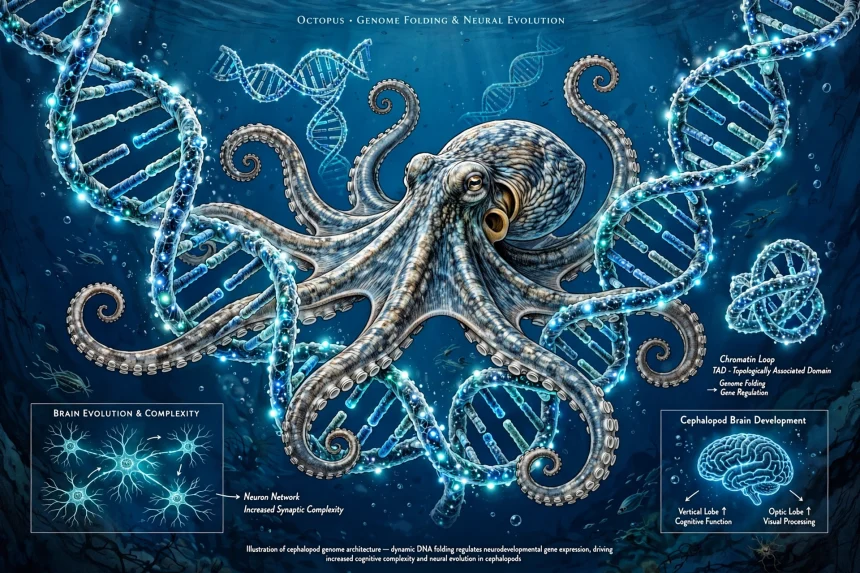
Octopuses can solve problems, squid can change colour in an instant, and cuttlefish are masters of camouflage. How animals so distant from vertebrates evolved such large, elaborate nervous systems has long puzzled biologists. New research from the University of Vienna suggests part of the answer lies not only in which genes these animals have, but in how their DNA is folded in three dimensions.
The study, published in Nature Communications, reconstructed the 3D organisation of the genome in octopus, squid and cuttlefish — the group known as coleoid cephalopods — and linked an ancient reshuffling of their genome to new ways of regulating genes, including genes involved in the nervous system.
A Genome Is More Than a List of Genes
DNA inside a cell is not a straight string. It is folded into a complex three-dimensional structure, and that folding decides which regions lie close together and can influence each other. Lead author Dr Thea Rogers summarises the idea briefly: “The genome isn’t just a sequence of genes.” Understanding how that folded structure itself evolves, the team argues, is becoming central to explaining how new biological complexity arises.
To test that idea, the researchers combined data on DNA structure with data on gene activity across the three cephalopod lineages. A summary of the work is available from the University of Vienna, and the paper itself appears in Nature Communications.
An Ancient Reshuffle With Lasting Effects
Hundreds of millions of years ago, the cephalopod genome went through a large-scale burst of reorganisation. Chromosomes were dramatically reshuffled, bringing regions of DNA that had once been far apart into close proximity.
Proximity matters. When two regions of DNA are brought into contact, they can start to interact and influence each other’s activity. Over evolutionary time, the researchers found, those new contacts can become embedded, forming increasingly interconnected regulatory networks. They describe this process as “regulatory entanglement” — a state in which new interactions allow a genome to produce novel patterns of gene expression while still preserving essential functions.
That balance between innovation and stability may help explain a familiar evolutionary puzzle: how a lineage can develop striking new traits without breaking the basic systems it needs to survive.
Stable Domains, Flexible Loops
Not every level of genome architecture changed at the same pace. Large structural units known as chromatin domains remained largely stable over evolutionary time, providing a conserved scaffold. Finer-scale connections known as chromatin loops were far more dynamic.
Loops bring distant stretches of DNA together for regulation, and in this study they varied widely across species, tissues and developmental stages. Crucially, they were often found near genes involved in key cephalopod traits, including genes linked to the nervous system. The authors suggest these flexible regions may be especially sensitive to large-scale changes in DNA organisation, and therefore especially important when new traits emerge.
For students and general readers building their science knowledge step by step, our site also offers practical learning resources such as a practical guest posting plan for small businesses, which shows how structured thinking applies well beyond the laboratory.
Architecture That Shapes Evolution
Together, the findings challenge a passive view of genome architecture. Instead of treating 3D organisation as merely a by-product of evolution, the study presents it as an active influence on how evolution unfolds. In cephalopods, changes in folding and contact may have helped create the regulatory conditions from which unusually complex nervous systems could develop.
The work does not claim that folding alone created the octopus brain, and it does not reduce complex behaviour to a single genetic event. Genes, development, environment and natural selection all remain part of the story. What it adds is a mechanism that was easy to miss when genomes were read only as linear sequences: rearrange the map, and distant genes can become neighbours, regulators can find new targets, and entirely new patterns of activity can become possible.
Future research will need to test how directly specific loops and contacts affect specific nervous system genes, and whether similar entanglement followed genome reshuffling in other animal groups. If the pattern proves general, the lesson will extend far beyond cephalopods — that to understand how complex traits evolve, scientists need to study not just the letters of DNA, but the shape it takes inside the cell.