

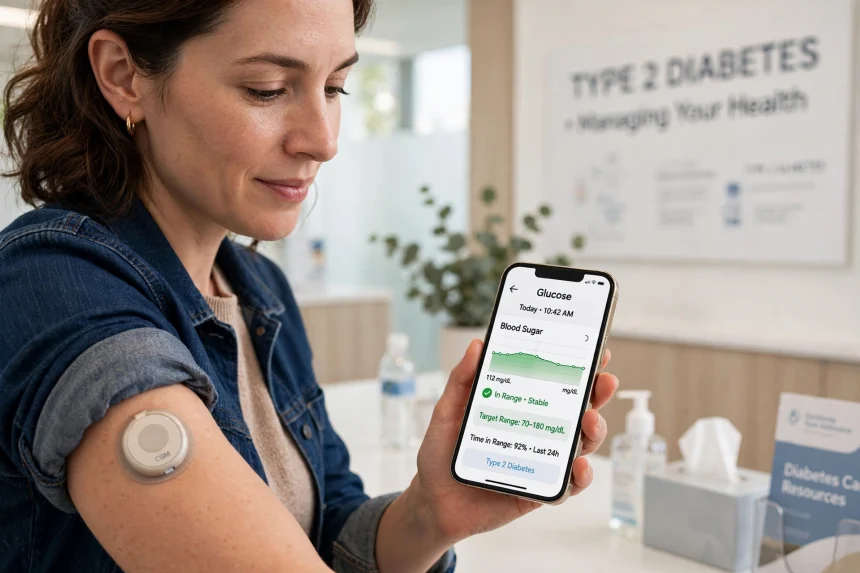
Adults with type 2 diabetes who do not take insulin gained about five extra hours a day in their target blood sugar range when they used a continuous glucose monitor, according to the largest clinical trial of its kind, published in the New England Journal of Medicine.
The result matters because this group is large and has historically been studied far less than people who use insulin. Researchers at the University of Colorado Anschutz and partner primary care practices say the evidence could help reshape guidance on who should be offered the technology, and who should have it covered by insurance.
What the Trial Tested
The randomized trial followed 283 adults for 26 weeks across 22 primary care practices in the United States. Participants received their diabetes care in primary care, where most Americans with type 2 diabetes are treated, rather than in specialist clinics alone. That design was deliberate: it tests whether the devices work in everyday care, not just in highly selected research settings.
A continuous glucose monitor, or CGM, uses a small sensor worn on the body to track glucose throughout the day and night. Instead of relying only on occasional finger-stick checks or a lab test every few months, patients can see how their levels respond to meals, activity and other daily habits, and adjust their choices with that feedback in view.
Details of the study and its findings were reported by CU Anschutz, and the full paper is available through the New England Journal of Medicine.
Five More Hours in Range, and a Better A1c
Time in range is a practical measure: it captures how much of the day a person’s glucose stays within a healthy target band. In this trial, CGM users spent roughly five additional hours a day in that band compared with people receiving routine care.
The lab results pointed in the same direction. Nearly twice as many people using a monitor reached an A1c below 7 percent, a common treatment goal, and the overall difference in A1c between the groups was 0.9 percentage points. The authors note that this gap is larger than what is generally considered clinically meaningful, meaning it is big enough to matter for long-term health, not just for a chart.
That distinction is important. Persistently high blood sugar raises the risk of serious complications over time, including heart disease, kidney disease and vision loss. Any intervention that reliably moves both daily time in range and A1c in a population that is not using insulin deserves close attention from clinicians and payers alike.
Why This Population Was Overlooked
First author Tamara Oser, a professor in the Department of Family Medicine at CU Anschutz, points out that an estimated 20 million adults in the United States have type 2 diabetes and do not take insulin, and many still do not reach glycemic targets despite advances in treatment.
Current American Diabetes Association standards give the strongest level of evidence support to CGM use for people receiving insulin. For people who do not take insulin, the supporting evidence has been rated much lower, reflecting how limited the earlier research was. Smaller studies had suggested a benefit, but none had the scale, multicenter design or primary care focus of this trial.
Readers interested in how regular tracking can support broader health goals may also find our coverage of how FitRx tracks progress during weight loss treatment useful, since consistent measurement is a theme in both settings.
What Happens Next
The researchers hope the findings will strengthen national diabetes care guidelines and support wider insurance coverage, making monitors accessible to more of the patients who could benefit. That will not happen automatically. Guideline committees will weigh this trial alongside other evidence, and coverage decisions vary by insurer and plan.
For now, the authors suggest that people with type 2 diabetes who do not take insulin talk with their primary care provider about whether a CGM fits their management plan. A monitor is not a substitute for medication, nutrition, activity or regular follow-up, and it adds cost and daily data to manage. But for many patients, seeing cause and effect in real time — how a walk, a meal or a poor night of sleep moves their glucose — may be the feedback loop that routine care alone has not provided.
If larger and longer studies confirm the same pattern, the five extra hours a day found here could become a turning point: evidence that a technology long associated mainly with insulin therapy also has a clear, measurable role for the much larger group managing type 2 diabetes without it.